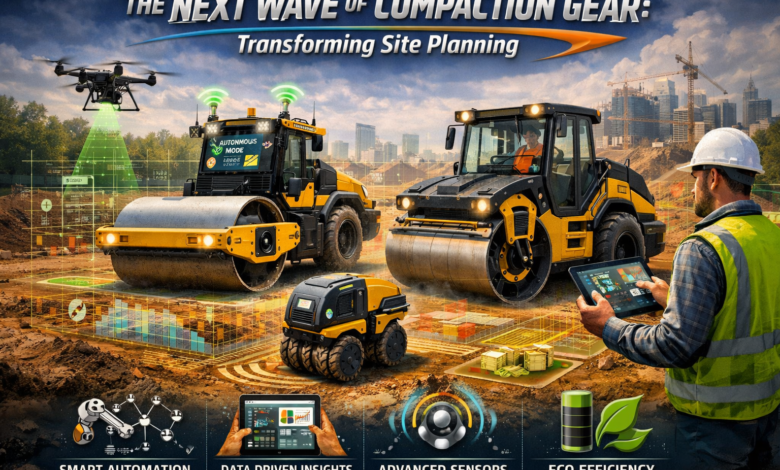
Most site plans are built around limitations. You work out what your equipment can’t do, and you plan around those edges. That’s been the default for years, and honestly, for good reason. A portable air compressor gets wheeled in to handle surface prep in areas your larger kit can’t reach, groundwork gets sequenced around what your compaction gear can realistically cover, and the timeline gets built accordingly. It works, but it’s a planning process driven by constraint rather than capability. The next wave of compaction equipment is starting to flip that.
When compaction dictated your timeline:
Go back five or six years on a mid-sized site, like a logistics park being built out. Without fail, you’ll notice the most issues in the compaction phase. Because the machinery wasn’t as flexible as it had to be.
You had a heavy kit that couldn’t get close to walls or structural edges without being a major risk. So, you’d use that to compact what you could and bring in smaller equipment to cover the rest. And you’d try to make the two passes into a consistent whole.
But it’s never simple. You’re trying to reconcile two different machines, with two different operators, and two different compaction depths into one uniform result. And you’d end up with surface inconsistencies that appeared weeks later, such as uneven settling or cracking along the margins. On a logistics park that’s going to take heavy forklift traffic daily, that’s a huge maintenance problem that keeps coming back.
The planning assumption behind all of this was that compaction was something you had to manage around. You brought in extra equipment for the awkward areas, and you were okay with the process being messy.
But that’s changing today.
How versatility changes the conversation:
The equipment has gotten better at handling more without being swapped out. Tandem rollers are where you see this most clearly. The newer ones can move between surface types and layer conditions in a way that the older ones simply couldn’t. They’ve got variable amplitude and are much better with weight distribution. And because of that, they’re extremely reliable and don’t need other smaller tools to finish their jobs.
Let’s take the same example from earlier. Imagine you’re laying out the yard for a new logistics hub. The old sequencing looked something like what we just talked about, two different tools expecting a consolidated result. It lost you time and, when you had to redo a lot of it, effort.
A modern tandem roller removes that variable entirely. It handles the primary pass and the transition zones without being swapped out, which means you’re getting a single, consistent result across the whole surface rather than two passes that you’re hoping will meet in the middle.
With this machine, you can start planning around what the site actually needs. And that’s a more honest starting point for a timeline anyway.
Tight sites, phased builds, and the access problem.
Dubai’s construction and industrial landscape has a particular characteristic that makes compaction planning more complicated than it might be elsewhere. Sites here are often being built in phases, with live operations running alongside active construction. For example, a warehouse expanding its yard while the existing facility continues to operate.
Here, smooth operations and accessibility matter the most. Your team and equipment need to get in and out without disrupting anything else. The older, bulkier compaction kit struggled with this. The machines were sized for open sites, and getting them through a more constricted phased build without damaging finished surfaces or creating bottlenecks in active areas required more effort and time than the crew had.
Newer compaction equipment is being designed with tighter sites in mind. They are more compact and are much better at mobility. And when your equipment can access more of the site without special accommodations, your phases can overlap more, you run on schedule, and the overall operation is as smooth as possible.
What double drum rollers specifically change about ground prep planning:
The conversation around ground prep has shifted most noticeably at the equipment level with double drum rollers. Older compaction approaches often needed multiple machine types to handle different layers. But modern double-drum rollers can give you all that within a single machine.
For site planners, that means fewer machines on site, which in turn means fewer coordination points and fewer logistics for fuel and maintenance, making your work go as efficiently as possible. These double drum rollers have made it easier to standardize your ground-prep approach across different site conditions. Instead of making equipment decisions on a zone-by-zone basis depending on what the ground is doing, you’re working with a more consistent toolkit.
That’s exactly what the next wave of compaction gear actually means for site planning. Machines are capable enough that your plan doesn’t have to work around them anymore.